How many kWh do you really need?
Why a larger battery is not automatically better or more cost-effective.
Read the article →
Explore wat je verbruik, teruglevering, contract of thuisbatterij voor jouw energiekosten kunnen betekenen. Met begrijpelijke uitleg en rekentools op basis van jouw eigen numbers.
We tonen mogelijke besparingen én kosten, leggen de aannames uit en helpen je opties rustig te vergelijken. Jij bepaalt zelf wat bij jouw situatie past.
Request no-obligation advice from up to three installers serving your postcode. You do not need to read all the information on this website first.
Kies een onderwerp. Je kunt eerst informatie bekijken en later beslissen of je een berekening of offerte wilt aanvragen.
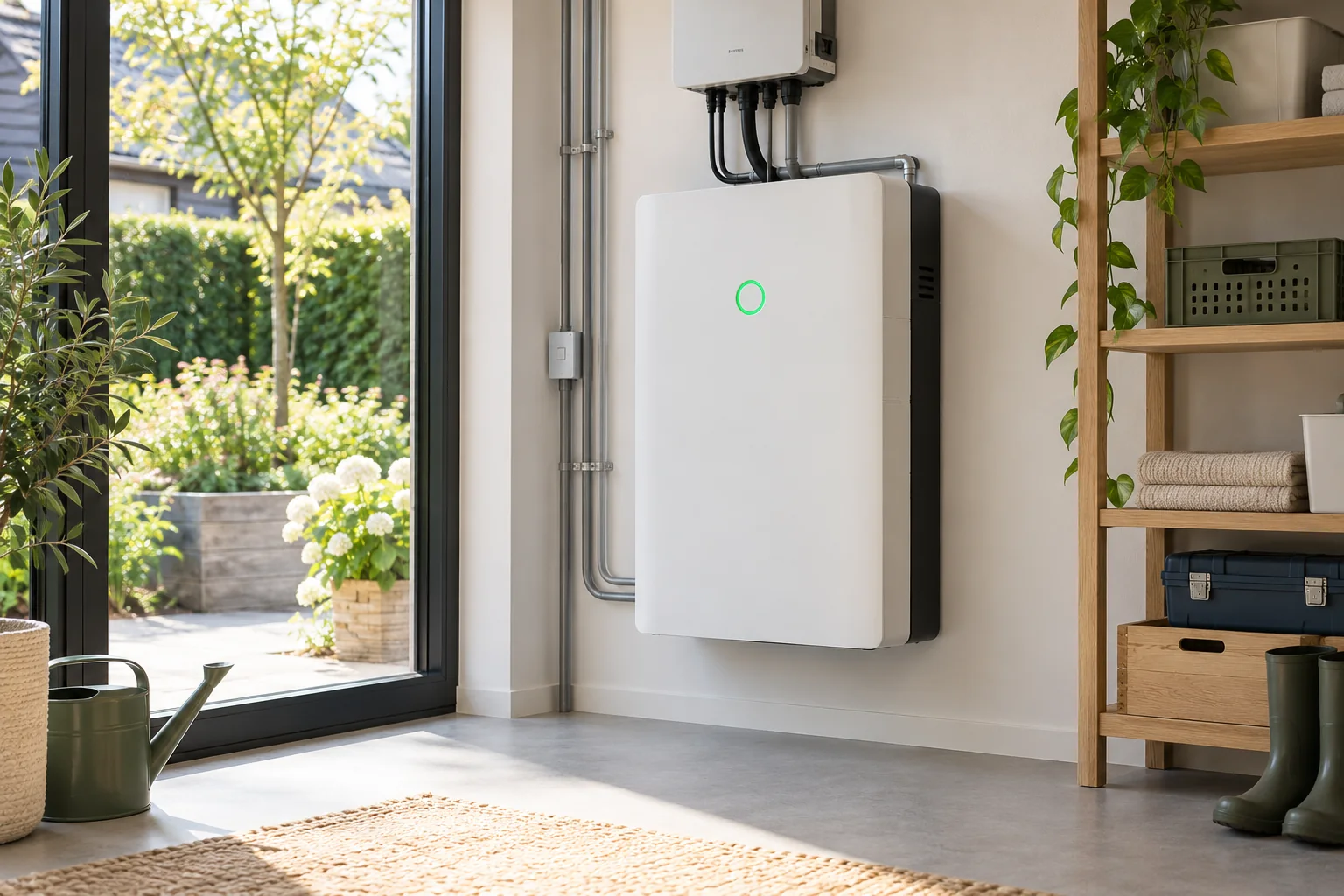
Bekijk eerst wat je zonnepanelen, verbruik en gewenste batterij betekenen voor de uitkomst.
Bekijk de berekening →Start the home battery guide →
Compare vaste, variabele en dynamische contracten op basis van je verbruik en teruglevering.
Compare contracts →Start the energy plan guide →
Bekijk hoe je contractkeuze en thuisbatterij elkaar kunnen beïnvloeden.
Bekijk de combinatie-keuzehulp →No generic sales pitch: the calculation starts with your own energy use, generation and needs.
Use information from your annual statement, solar panel app or smart meter.
Enter your annual electricity figures below for an initial estimate of your home battery storage needs.
This is a rough estimate. Extra electricity for an EV charger, heat pump or air conditioning is not included separately. Untick the box to use your own annual figures.
Your initial home battery storage estimate appears here automatically. Then choose the route below that suits you.
This is an initial estimate based on your annual electricity exports. Suggested capacity is calculated by dividing that figure by 365, rounding to the nearest half kWh and limiting the result to between 3 and 20 kWh. Potential energy storage assumes at most one full cycle per day and 90% efficiency. This is a theoretical upper limit: seasons, available surplus and when you use electricity affect how much you can actually store. Savings and payback cannot be calculated without your actual electricity rate and export payment.
Using averages: For electricity imported from the grid, we use Nibud’s 2025 reference figures published by the Huurcommissie: 1,640, 2,550, 3,080, 3,600 and 3,980 kWh for households of one to five people. For five or more people, we use the five-person figure; larger households may use more. We estimate solar generation at 380 kWh per panel per year, based on Milieu Centraal’s example of ten 435 Wp panels. We assume 30% is used directly and 70% is exported. Panel age, orientation, shading and your usage may change the result. These are calculation assumptions, not measured annual figures.
Sources, checked on 24-10-2026: Huurcommissie / Nibud and Milieu Centraal.
Read about VAT refunds on home batteries →
Practical guidance on energy costs, home batteries and tariffs, including what a calculation cannot predict.

Why a larger battery is not automatically better or more cost-effective.
Read the article →
See which factors could make a difference for your household.
Read the article →
What the end of net metering means for self-consumption and exported electricity.
Read the article →Once you understand your needs, you can focus on suitable solutions and suppliers.
Compare available home batteries and see which features match your figures.
Compare home batteries → Energy contractCompare tariff types, terms, export charges and current offers.
Start the energy plan guide → Smarter energy useExplore smart charging, direct self-consumption and combining a tariff with a battery.
Explore your options →Some links or partner listings may earn us a fee. How we work with partners →
No. The result depends on factors including your electricity use, solar panels, tariff, battery price and how the battery is controlled.
Net metering ends on 1 January 2027. After that date, exported solar electricity can no longer be offset against your electricity use.
Yes. After your personal estimate, the site is designed to let you compare different solutions and providers side by side.
Calculate first. Compare next. Choose what suits you.